Why Do Genealogists Get Overwhelmed?
What Does an Overwhelmed Researcher Look Like?
What makes a confident researcher different from an overwhelmed researcher? Oh boy, I have resembled both of those in my life.
An overwhelmed researcher may have lots of questions and lots of possibilities in front of them. They may have records they’ve found, searches they’ve run, notes they’ve taken, and hints waiting for them on one of the big genealogy sites. But somewhere along the way, they lose track of what they’re actually doing.
Maybe they can’t remember what they searched yesterday or last week. They aren’t sure whether they’ve already looked for a particular record. They sit down to research and don’t know what to do next. Sometimes they don’t even know exactly where they left off.
I’ve been there. You have all this information in front of you, but instead of feeling like you’re making progress, you feel lost in it.
And having lots of questions isn’t the problem. I think we all do. Part of what makes genealogy so exciting is finding the people who are yours. They don’t have to be famous or remarkable. They’re just your people. That excitement is real, and it’s part of what keeps me doing genealogy today.
But that excitement can also pull us in a dozen different directions. We see a hint and start clicking. One thing leads somewhere, which leads somewhere else, and before long, we aren’t really directing our research anymore. We’re just following whatever comes next.
We go where the wind blows.
And eventually, we may look up and realize we don’t know where we are anymore.
Overwhelm Comes From Not Knowing Where You’re Going
Think about what would happen if you tried to travel that way.
Suppose I told you I wanted to go to RootsTech in Salt Lake City and asked you to tell me how to get there. Before you could give me directions, you’d need to know something important: where am I starting from?
Am I in London? Seoul? New York City? Each one can get me to Salt Lake City, but the route from each place is going to be very different.
You’d also need to know the specific place I’m actually trying to get to. “I want to go somewhere in Utah” isn’t enough. Even “I want to go to Salt Lake City” may not be enough if what I really need is directions to the Salt Palace. The more clearly I understand my destination, the easier it becomes to figure out how to get there.
Genealogy works much the same way.
When I’m overwhelmed by my research, I need to get my bearings. I will ask myself, Where am I starting from? Where am I trying to go? What routes might get me there? Where have I already been?
I don’t need to know the entire journey yet. But I do need to know where I am and where I’m trying to go before I can decide what to do next.
Start With What You Know
The first thing I need to figure out is where I’m starting from. That brings me back to something I teach all the time: start with what you know.
In genealogy, we generally work from the present backward, connecting one generation to the next. Could you give me the name of someone who lived in the 1800s and a little information about them and have me search for them? Sure. But it’s much easier if I know who their children or grandchildren were and I’ve worked backward from the present to that person.
Each generation gives me information that helps me identify the one before it. If all I know is that someone was named John Smith and born in England, I probably don’t know enough yet to be reasonably sure I’m researching the right John Smith. I don’t want to start building a family around John Smith the tailor in London when my John Smith was a farmer outside Aberdeen, Scotland.
Sometimes, though, I know quite a bit. Suppose I’m trying to learn where my great-grandmother was born. I may already know her name, the approximate year she was born, her husband, and at least one of her children because I know who my grandfather was. I don’t know everything about her, but now I have a starting point.
And sometimes, when I stop and look at what I actually know, I realize I’m not ready to answer the question I originally wanted to answer. Maybe I want to know where my great-grandmother was born, but I don’t have enough reliable information to identify her confidently.
That’s okay. I can put that question aside for a little while and first verify the information I already have. Before I use that information to guide the rest of my research, I want to make sure I have a solid starting point.
So before I decide where I’m going, I need to know where I’m starting from. Start with what you know.
Ask One Question at a Time
Knowing where I’m starting from is only part of getting my bearings. I also need to decide where I’m trying to go.
When I first started researching, that was something I didn’t understand at all. I’d go to the Family History Library, walk up to the counter, and tell one of the professional genealogists, “I want to find out about this person.”
They’d ask, “What do you want to know?”
“Everything.”
That was pretty much all I knew in the beginning. I wanted to know everything about the person, but “everything” wasn’t a destination I could actually research.
A few months after I started going to the library every week, I met a professional genealogist who spent every Saturday there. I wish I knew his name. Maybe I did when I was younger and my memory has faded over the years, but he made an enormous difference in how I learned to research.
At first, I thought he was grumpy as all get out and didn’t want to deal with a 14-year-old who had a million questions.
But every time I came to him with one of my big questions, he would make it smaller.
I’d ask, “Where can I find this?”
He might respond, “Well, where did they live?”
“I don’t know.”
“Okay, maybe we should figure out where they lived first. Go check the census records.”
So I’d go over to the census records—and realize I didn’t know how to use them. Back I’d go with another question.
We did this one step at a time, one question at a time, nearly every Saturday until I graduated from high school. He taught me how to methodically work through a problem: What is my question? What might answer that question?
Then I could learn whatever I needed for that step.
That’s still how I approach a huge genealogy project. I don’t have to figure out everything I want to know about someone all at once. I need a specific question that gives me somewhere to go.
Then I can work through the research one question at a time.
So I ask myself: What is the one question I’m trying to answer right now?
Make a Plan
Once I know where I’m starting from and have a specific question I’m trying to answer, I can start figuring out how I might get there.
If you’re just starting out, grab a research log—or a piece of paper if that’s all you have—and write down your question. Then think about the records or sources that might help you answer it and where you might find them.
When I make my plan, I ask myself: What records or sources might answer my question? Where can I look for them?
Think of those possibilities as different routes to your destination. There’s no guarantee that any one route will get you there trouble-free. That’s okay. Pick one and try it. If that doesn’t work, you can come back and try another route.
Work Your Plan One Step at a Time
Once I have a plan, I don’t have to do everything at once. I pick one of the routes I’ve identified and start there.
Most of us can’t spend 12 hours a day, five days a week doing genealogy. I certainly can’t. I might have several records I want to search, get through two or three of them, and then life happens.
The problem comes when I return to the research. Sometimes I remember what I’d searched and what I’d found. Sometimes I remember what I’d searched but couldn’t remember the results. Other times, I only partially remember.
That’s how I’ve ended up duplicating my work.
There is nothing quite like finding a record and thinking, “I swear I’ve seen this before.” I’ve even spent an hour finding a document, downloading and saving it, only then to discover I’d already found and saved the exact same thing before. I just hadn’t documented it.
Writing things down wasn’t something I enjoyed when I first started. I wanted to do the exciting part. I wanted to find the records, find my people, and know where I came from—and I wanted it all yesterday.
Documentation just wasn’t as thrilling as the finding. But without it, I couldn’t always tell where I’d already been.
That’s why one of the questions I ask when I’m trying to get my bearings is: Where have I already been?
So as I work through my plan, I record what I’ve searched and what I’ve found, including the things that didn’t answer my question. Then, when I come back tomorrow, next week, or even months later, I can see where I left off.
And if one route turns out to be a dead end, future me will know I’ve already been down that road. I won’t accidentally take it again. I can then easily go back to my plan and try the next route.
Confidence Doesn’t Mean Knowing Everything
So what does a confident genealogist look like?
I don’t think it’s someone who knows everything. A confident genealogist knows how to get from A to B. They know how to start with what they know, ask a question, make a plan, and keep going.
Having that process changes how I look at a huge genealogy project. Instead of seeing everything I don’t know and everything I still have to do, I can say, “That’s too big. I don’t need to do that whole thing right now. Let me start with something smaller.”
And that changes what happens when I run into something I don’t know how to do. I don’t have to know how to solve every problem before I begin. I only need to figure out what I need for the step I’m working on now. If I don’t know how to do that yet, I can learn.
That’s an important difference. Confidence doesn’t come from knowing every record, every website, or every research technique you might ever need. For me, it comes from knowing how to keep moving when I don’t know everything, and trusting that I can figure out what to do next.
A confident genealogist doesn’t need to know the whole route. They need to know how to find the next step.
Comparison Can Add to the Overwhelm
There’s one more thing I wish every overwhelmed genealogist understood: genealogy isn’t a competition.
It’s easy to look at another genealogist and see how much they’ve researched, how much they seem to know, or how easily they seem to know what to do next—and compare that with where you are.
Maybe they’ve traced ten generations and you’re still working on your great-grandparents. Maybe they’re using records you’ve never heard of. Maybe they seem to know exactly what they’re doing while you’re still trying to figure out what to do next.
And suddenly you’re thinking, I’ll never be that good. I’ll never know as much as they do. I should be farther along than I am.
This isn’t a competition. You’re not competing with anyone.
Comparison can make the genealogy project in front of you feel even bigger than it already is.
Their research isn’t your research. The question you’re trying to answer right now doesn’t change because someone else has traced ten generations or knows how to use a record you’ve never worked with before.
So come back to your own research. Get your bearings, and figure out where you’re going next.
That’s the research in front of you.
You Can’t Solve Everything at Once—and You Don’t Need To
A genealogy project is always going to be huge. There will always be another person to find, another record to search, another question to answer, and probably something you don’t know how to do yet.
The good news is that you don’t need to solve all of that today.
When your research starts to feel overwhelming, stop and get your bearings. Figure out where you are starting from, where you’re trying to go, what routes might get you there, and where you’ve already been.
Then decide what to do next.
Sometimes that next step will answer your question. Sometimes it won’t, and you’ll go back to your plan and try another route. Sometimes you’ll discover that you need to learn something before you can continue.
That’s how research works.
You don’t need to know the entire route. You just need to get your bearings and take the next step.
Image Credit
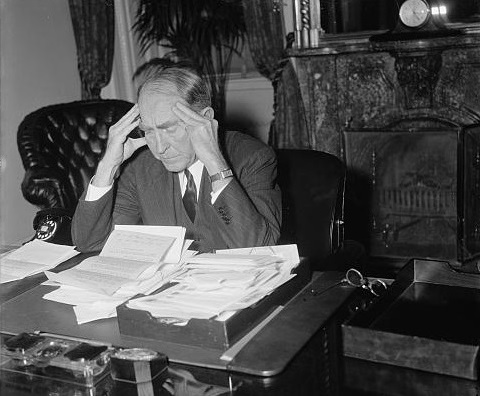
Photo by Harris & Ewing. “Headaches anew for Speaker. Washington, D.C., Dec. 22.” 1938. Library of Congress, Harris & Ewing Collection. No known restrictions on publication.